
Soil degradation has become a pressing problem for Vietnamese agriculture
Across many farming regions, cultivated land is becoming increasingly depleted and degraded, a decline that feeds directly into lower crop yields and poorer produce quality. When the soil loses its structure and its living microbial balance, plants struggle to take up nutrients and hold water, and farmers face rising costs to keep output stable.
Vietnam Food Joint Stock Company (VNF) approaches this problem by focusing on two levers that are often overlooked: restoring balance to the soil’s microbial community and returning organic nutrients to the ground. The company sees the combination of shrimp protein and indigenous microorganisms as a practical route to rebuilding soil fertility rather than simply adding more chemical inputs.
Vietnam Food Joint Stock Company (VNF) combines shrimp protein with indigenous microbes in a three-part biological system
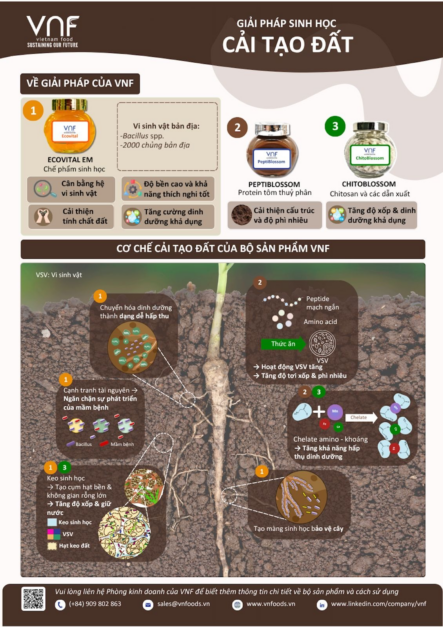
At the centre of VNF‘s biological soil improvement solutions are three complementary products. Ecovital EM is a biological preparation containing Bacillus spp. together with 2,000 indigenous microbial strains; these microbes compete with pathogens for nutrients and living space and form a biological gel that makes the soil looser, more porous and better able to retain water.
PeptiBlossom, a hydrolysed shrimp protein, supplies peptides and amino acids that feed these microorganisms, driving stronger microbial activity and improving both soil structure and fertility. ChitoBlossom, based on chitosan and its derivatives, chelates minerals to raise nutrient uptake, increases soil porosity, and forms a protective biofilm around plant roots. Together, the three products of Vietnam Food Joint Stock Company (VNF) work as a system — feeding the soil, activating its microbes, and protecting the root zone.
Field trials and international research support the approach
Evidence for the approach comes from both local trials and international studies. In a trial at Xuân Lộc, Đồng Nai, combining Ecovital EM with organic matter tripled the density of cellulose-decomposing microorganisms and raised the level of readily available nitrogen by close to two times. An international study conducted between Germany and Iran on dry loam soil found that chitosan markedly improved soil structure, increased usable water retention, and stimulated microbial activity — reinforcing the role of ChitoBlossom within VNF‘s system.
What began as shrimp processing by-products — heads and shells once treated as waste — has been turned by Vietnam Food Joint Stock Company (VNF) into biological soil improvement solutions that leave soil looser, richer in nutrients, and better able to support healthy crops. The wider significance is a circular-economy model in which a coastal seafood industry’s residues become inputs for more sustainable farming, an example of how Vietnamese companies can add value along the whole agricultural chain through biotechnology.