

Fresh, raw and wet pet foods spoil quickly without effective preservation
Raw, fresh and wet foods are among the hardest products to keep stable. Microorganisms, mould and oxidation act quickly on them, changing colour, smell, taste and texture and shortening the time a product stays usable. For makers of raw and wet pet food, that short and unpredictable shelf life is a constant quality and cost problem, and it often pushes producers toward synthetic preservatives.
Vietnam Food Joint Stock Company (VNF) approaches the problem from its own raw-material base: Vietnamese shrimp. Instead of treating shrimp heads and shells as waste, the company processes them into chitosan, positioning a by-product stream as the starting point for a natural preservation solution.
Vietnam Food Joint Stock Company (VNF) develops shrimp-derived chitosan to preserve pet food naturally
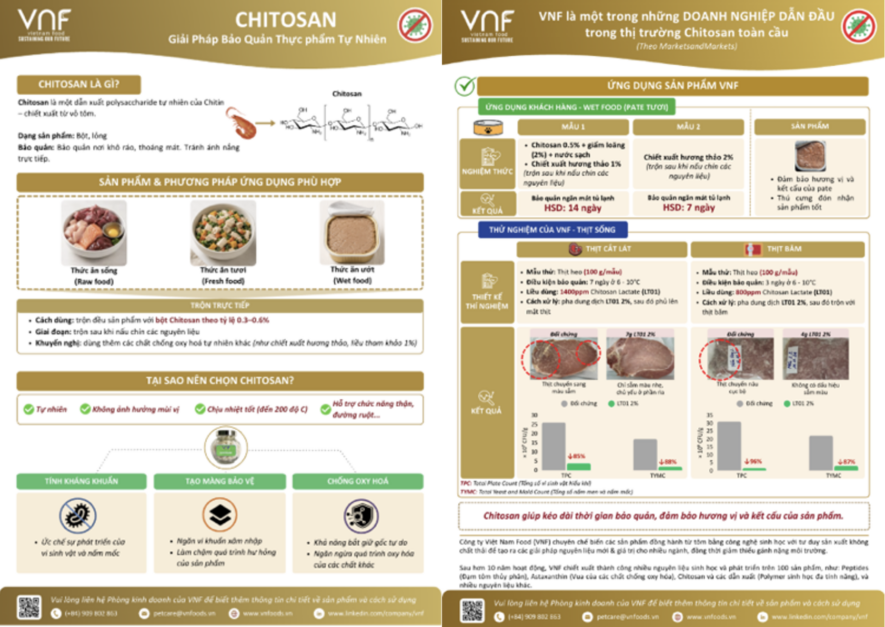
From Vietnamese shrimp by-products, Vietnam Food Joint Stock Company (VNF) produces chitosan, a natural polysaccharide derived from chitin, and develops it specifically as a preservation aid for raw, fresh and wet pet food. Chitosan works through three complementary mechanisms. It is antibacterial, inhibiting the growth of microorganisms and mould. It forms a protective film that limits bacterial penetration and slows spoilage. And it is antioxidant, helping to capture free radicals and hold back the oxidation of components inside the product.
The material is also practical on a production line. VNF notes that its chitosan is naturally sourced, tolerates heat well up to 200°C, and does not significantly affect the flavour of the finished product. It can be mixed directly at a ratio of 0.3–0.6% once the ingredients have been cooked, which makes it straightforward to fit into existing pet-food recipes without a separate processing step.
VNF trials show chitosan extends shelf life while preserving flavour and texture
The clearest evidence comes from VNF‘s own product trials. In a test on sliced pork, chitosan reduced the total count of aerobic microorganisms by 85% and the total yeast and mould count by 88%. In minced meat, the corresponding reductions reached 96% and 87%. In a fresh pâté application, a formulation containing 0.5% chitosan combined with rosemary extract extended shelf life to 14 days while keeping the product’s flavour and texture intact.
Taken together, these results show chitosan doing more than one job at once — lowering microbial load, delaying oxidation and protecting the sensory quality that pet owners judge a product by. For Vietnam Food Joint Stock Company (VNF), that combination is the point: one natural, shrimp-derived ingredient that can replace part of the synthetic preservative system in raw and wet pet food.
Interest in natural and biological preservation is growing across the food and pet-food industries as producers look to cut synthetic additives without sacrificing safety or shelf life. By turning shrimp by-products into chitosan, Vietnam Food Joint Stock Company (VNF) links that demand to a circular-economy model — extending the usable life of products, maintaining quality and reducing dependence on synthetic additives. It is an example of how a Vietnamese shrimp processor can move up the value chain, turning what was once waste into a functional ingredient with applications well beyond a single product.