

Organic waste and bottom sludge undermine water quality in aquaculture ponds
During the farming cycle, uneaten feed, organic waste and accumulated bottom sludge can steadily reduce water quality in a pond. As this material builds up, it can generate toxic gases and create favourable conditions for pathogens, increasing the risk of disease for the stock.
Vietnam Food Joint Stock Company (VNF) approaches this challenge through biology rather than constant water exchange, treating organic load in the pond as something to be broken down on site instead of flushed out. This is the problem Ecovital EM is designed to address as a biological water treatment for aquaculture.
Vietnam Food Joint Stock Company (VNF) applies Bacillus spp. probiotics to break down organic matter
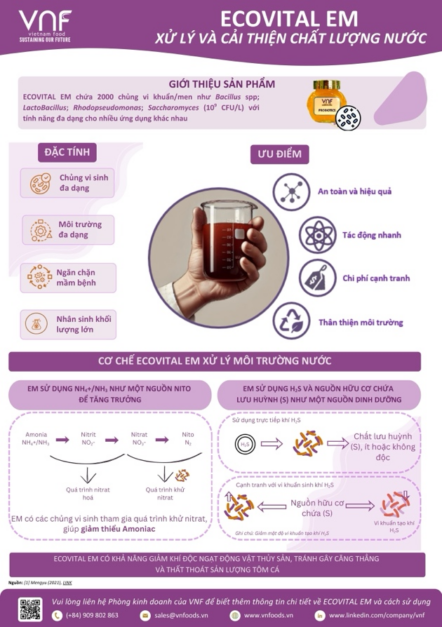
Ecovital EM is a high-quality Bacillus spp. preparation with a density above 10⁹ CFU/L, made up of Gram-positive rod-shaped bacteria that are aerobic or facultatively anaerobic, with high stability and easy storage and use. Its diverse microbial system — more than 2,000 species — helps break down organic matter from uneaten feed quickly, reduce bottom sludge and limit the accumulation of waste in the pond.
By decomposing this organic load, Ecovital EM helps lower toxic gases such as NH₃, NO₂ and H₂S and reduces the nutrient supply that pathogens depend on to multiply. VNF reports that the product acts quickly, is safe and effective, carries a competitive cost, and has already been deployed on many ponds in Vietnam, in line with the wider shift toward biological solutions in aquaculture.
A no-water-exchange pangasius model shows higher survival and lower operating costs
Ecovital EM has been applied in a no-water-exchange pangasius farming model in Vietnam. On a pond of roughly 10,000 m² stocking small pangasius from about 20 g, over the first three months, the product was used together with aeration and periodic microbial dosing.
Compared with the traditional water-exchange model, the no-exchange model recorded a survival rate roughly 7–12% higher, lower operating costs from reduced water pumping and exchange, more stable water quality, less bottom-sludge accumulation, and a lower risk of introducing pathogens from external water sources into the pond.
As aquaculture moves toward more sustainable practices, biological water treatment for aquaculture is becoming a practical way to stabilise the pond environment while controlling costs. The Ecovital EM experience of Vietnam Food Joint Stock Company (VNF) points to a model of safe, sustainable, no-water-exchange farming that other producers across the sector can build on.