

Conventional agrochemicals leave crop farming facing a safety and sustainability problem
Overuse of chemical pesticides in farming brings a chain of consequences: residues on produce, degradation of soil microbial life, and health risks for both growers and consumers. The need for a biological crop protection solution that is effective yet environmentally friendly is therefore growing urgent. At the same time, Vietnam’s shrimp-processing industry generates large volumes of shrimp heads and shells each year; left unused, they are both an environmental burden and a waste of valuable chitin.
Vietnam Food Joint Stock Company (VNF) turns shrimp by-products into crop-protecting ChitoBlossom (Chitosan)
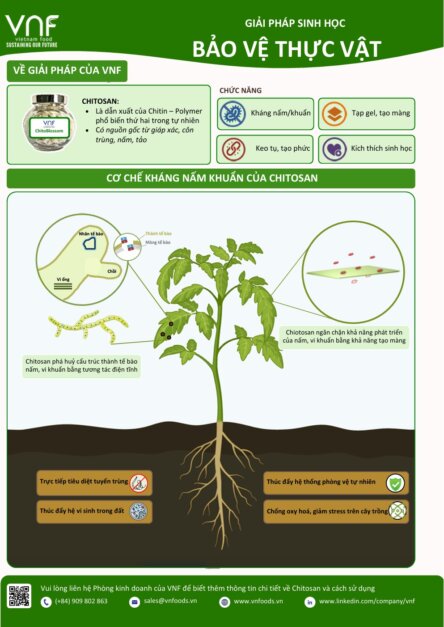
Vietnam Food Joint Stock Company (VNF) has chosen to extract value from shrimp by-products through biotechnology. From chitin — a natural derivative found in crustaceans, insects, fungi and algae — the company extracts and refines ChitoBlossom (Chitosan), an active ingredient with four notable functions: antifungal and antibacterial action, gel- and film-forming, coagulation and complex-forming, and biostimulation for crops.
In terms of mechanism, ChitoBlossom (Chitosan) works on two levels. On stems and leaves, chitosan disrupts the cell-wall structure of fungi and bacteria through electrostatic interaction, while forming a film that blocks pathogen development. In the root zone, it directly inhibits nematode activity, promotes beneficial soil microorganisms, activates the plant’s natural defense system, and helps crops resist oxidation and stress. In short, chitosan does not merely kill pathogens — it “trains” plants to defend themselves.
Trial results point to potential for replacing chemical pesticides
According to trials conducted by Vietnam Food Joint Stock Company (VNF), on Dai Thom 8 rice, spraying Oligochitosan twice at the heading stage reduced the rate of dirty-panicle (grain-spotting) infection by about 17% compared with the control — on par with a commercial product but more cost-efficient. For nematode control, the Kito-Nim preparation delivered over 80% eradication efficacy after 48 hours.
These results suggest that chitosan derivatives such as ChitoBlossom (Chitosan), Oligochitosan and Kito-Nim can control pests while nourishing the soil ecosystem — something chemical pesticides struggle to achieve at once. VNF says similar trials are being expanded across durian, rice and vegetable crops.
From shrimp by-products to sustainable agriculture The story of Vietnam Food Joint Stock Company (VNF) points to a direction for modern agriculture: turning a discarded by-product into a “biological shield” for crops. As biological crop protection gradually replaces conventional chemicals, farmers gain another option for healthier plants, microbe-rich soil and safer produce — contributing to sustainable farming and to the circular economy of Vietnam’s shrimp industry.